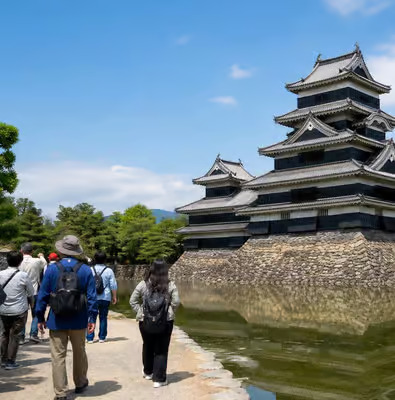
Matsumoto is a city worth more than an afternoon. The castle is the centrepiece, but what surrounds it — streets of Edo-period storehouses, small sake bars, a world-class ukiyo-e museum, buckwheat noodle restaurants, and, 40 minutes further on, one of Japan's most beautiful alpine valleys — makes Matsumoto one of the most rewarding stops in Central Japan. Here is everything worth doing, roughly in order of proximity to the castle.
1 Nawate-dori · 3 min walk from the castle
The street running along the Metoba River immediately south of the castle moat is Nawate-dori — a narrow, retro shopping street unofficially dedicated to frogs. The Metoba River was historically home to large frog populations, and the street leaned into its frog identity with characteristic Japanese thoroughness: frog figurines, frog ceramics, frog souvenirs, and frog-themed snacks line the shopfronts in a way that reads as eccentric but is entirely genuine.
More practically, Nawate-dori is the best single street in Matsumoto for souvenir shopping — wasabi products, local sake, Nagano apple confectionery, traditional crafts — at prices that haven't been inflated for tourist volume. It closes around 17:00–18:00, so go before your castle visit or immediately after.
Covered on tour: The Matsumoto Castle Town & Nawate Street Photo Walk and the Half-Day Walking Tour both include Nawate-dori with a guide who knows the specific vendors worth stopping at.
2 Nakamachi-dori · 8 min walk from the castle
One block south and parallel to Nawate-dori, Nakamachi-dori is Matsumoto's most elegant street — a preserved row of Edo-period kura storehouses in white plaster and black-painted lattice, many now operating as cafes, galleries, and craft shops. The architecture dates from the 18th and 19th centuries and has been carefully maintained, giving the street a visual coherence that most Japanese castle towns have long since lost to development.
A good kura cafe stop for lunch or coffee: most open around 11:00 and close by 17:00. The Sake Bar Macchan on Nakamachi is a small, genuinely local venue — three seats at the counter, seven Nagano labels on the shelf, no English menu but a proprietor who communicates through enthusiastic pointing.
3 Matsumoto City Art Museum · 10 min walk from the castle
The Matsumoto City Art Museum is primarily known as the home of a major permanent collection of works by Yayoi Kusama — the Matsumoto-born artist whose infinity mirror rooms and polka dot paintings have made her one of the most recognisable artists in the world. The outdoor installation visible from the street (large pumpkin sculptures, polka-dotted pillars) gives a sense of the museum's personality before you go in.
Beyond Kusama, the museum holds collections of Matsumoto lacquerware and contemporary Japanese art. Allow 1–1.5 hours.
4 Former Kaichi School · 12 min walk from the castle
Built in 1876, the Former Kaichi School is a National Treasure in its own right — Japan's first modern school building in the Western style, combining Meiji-era enthusiasm for European architecture with traditional Japanese craftsmanship. The result is a distinctive two-story building with a central tower, ornate window surrounds, and an interior that has been preserved as a museum of Meiji-era education.
The contrast with the feudal castle seen an hour earlier — both designated National Treasures, separated by nearly 300 years of Japanese history — is genuinely thought-provoking. The Private Architecture Walk tour includes the Kaichi School as an optional extension.
5 Matsumoto Soba · Throughout the city
Nagano Prefecture is Japan's premier soba-growing region, and Matsumoto is one of the best cities in the country to eat it. The local style — Shinshu soba — uses locally grown buckwheat, ground fresh, and served cold on a bamboo seiro with dipping broth, wasabi, and spring onion. It is as far from restaurant-chain soba as fresh pasta is from dried.
Most soba restaurants around the castle are lunch-only, opening at 11:00 and selling out by 13:30. Masakiya (5 min from the castle, cash only) and Kura-jo (in a restored kura on Nakamachi-dori) are consistently recommended by locals. Or book the Castle + Soba Noodle Making Experience and make your own.
Castle + Soba Noodle Making — From $91
Tour the keep then knead, roll, and cut your own buckwheat noodles with a soba master. Eat what you make. Entry included.
Book the Soba Experience6 Japan Ukiyo-e Museum · 20 min by bus from the castle
The Japan Ukiyo-e Museum holds one of the largest private collections of Japanese woodblock prints in the world — over 100,000 works, including first editions of Hokusai's Great Wave and Hiroshige's Tokaido series. The collection is held across five kura (fire-proof storehouses) and rotates displays throughout the year.
This is one of the genuinely underrated cultural institutions in Japan — extraordinary depth, minimal crowds, and a permanent collection that would rank among the finest in any major world city. The Matsumoto Everything full-day tour includes the museum.
7 Daio Wasabi Farm — Azumino · 40 min by bus
Japan's largest wasabi farm occupies a glacial spring-fed field in the Azumino valley, 40 minutes north of Matsumoto by bus. The Daio Wasabi Farm (Daio Wasabijo) is open to visitors year-round — you walk through working wasabi paddies fed by crystal-clear mountain water, eat wasabi-flavoured snacks, and buy products unavailable anywhere else. The landscape of terraced green paddies and water channels is unexpectedly beautiful.
The farm appeared in the Akira Kurosawa film Yume (Dreams) — the watermill scene was filmed in the south paddies. Tours including the wasabi farm: the Matsumoto Everything full-day tour is the most comprehensive.
8 Kamikochi Alpine Valley · 90 min by bus
Kamikochi is one of Japan's most famous mountain landscapes — a car-free 1,500-metre alpine valley in the Chubu Sangaku National Park, crossed by the glacially clear Azusa River and bordered on all sides by the Hotaka peaks. Japanese macaques are regularly spotted along the river trail. The valley is accessible only by bus (private vehicles banned) between April and November, closing in winter.
The Castle + Kamikochi full-day tours combine the castle in the morning with several hours at Kamikochi in the afternoon. This is the optimal way to visit both — the bus transfers are handled by the tour operator and you arrive at Kamikochi with several hours of free walking time in the valley before the return journey.