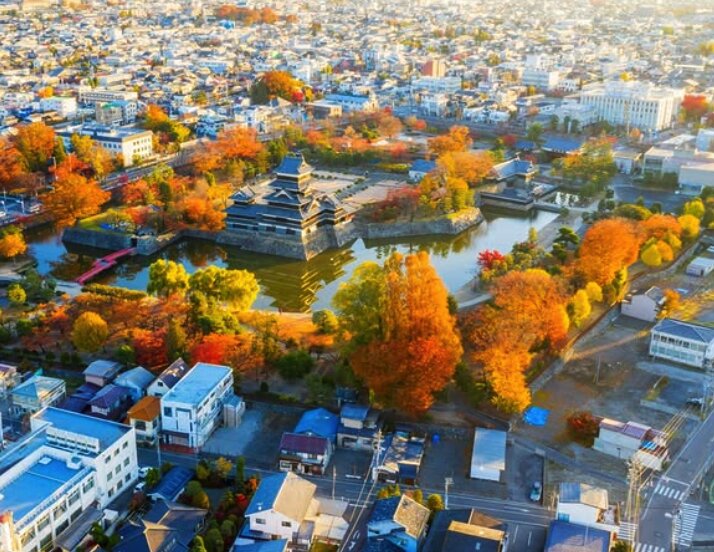
Matsumoto Castle has stood on the same Nagano plain for over 430 years — never burned down, never reconstructed, never lost to siege or earthquake. That survival is the core of what makes it extraordinary among Japan's remaining castle keeps: what you see today is genuinely what was built in 1593 and 1594. This is the full story, from the first fort on the site in 1504 to its National Treasure designation in 1952.
1504
Fukashi Castle built by the Ogasawara clan
1548
Takeda Shingen drives out the Ogasawara; controls the castle
1590–1594
Ishikawa Norimasa builds the keep we see today; castle renamed Matsumoto
1630s
Moon-Viewing Turret added with vermillion railings
1872
Near-demolition; saved by public campaign
1952
Designated a National Treasure — Japan's highest cultural protection
1504 — Fukashi Castle and the Ogasawara Clan
The site now occupied by Matsumoto Castle began as a modest fortification called Fukashi Castle, built in 1504 by Shimadachi Sadanaga under the authority of the Ogasawara clan. The Ogasawara were the dominant power in Shinano Province — present-day Nagano Prefecture — during the early Muromachi period, and Fukashi served as a regional administrative base rather than a full military fortress.
The Sengoku period (Warring States, roughly 1467–1615) was closing in. Across Japan, daimyo warlords were absorbing neighbouring domains, and Shinano Province — positioned between the territories of the major eastern powers — was a constant battleground. The Ogasawara held Fukashi through the early 16th century, but their grip was fragile.
1548 — Takeda Shingen Takes Control
In 1548, Takeda Shingen — one of the most feared military commanders of the Sengoku era, known as the "Tiger of Kai" — launched a campaign through Shinano Province. The Ogasawara clan was defeated and expelled. Fukashi Castle and the surrounding plain came under Takeda control, serving as a northern staging point for Takeda operations toward the sea of Japan coast.
The Takeda clan held Shinano for over three decades, but their dominance ended abruptly. In 1582, Takeda Katsuyori was defeated by a coalition of Oda Nobunaga and Tokugawa Ieyasu. The clan collapsed, and Shinano Province changed hands multiple times over the following years as the unification wars played out across Japan.
Who was Takeda Shingen? A legendary warlord famous for his cavalry tactics and his long rivalry with Uesugi Kenshin. Their six battles at Kawanakajima — with Matsumoto's plain as part of the contested territory — are among the most storied engagements of the Sengoku period. Guides on the Castle Tour & Samurai Experience cover this history in detail.
1590–1594 — The Ishikawa Construction
After Toyotomi Hideyoshi unified Japan in the late 1580s, he reorganised the country's domains and assigned Shinano Province to Ishikawa Norimasa in 1590. Norimasa had a clear mandate: build a castle keep worthy of a major domain, in the European-influenced Azuchi-Momoyama style that Hideyoshi favoured.
The result — completed around 1593–1594 under Norimasa and his son Yasunaga — was the five-tiered, six-story keep that still stands today. Norimasa also gave the castle its current name: Matsumoto, taking the name of the castle town that had grown around the site. Fukashi Castle was gone; Matsumoto Castle had arrived.
The construction came at a pivotal moment in Japanese military history. Portuguese traders had introduced firearms to Japan in 1543 — just 50 years before the castle was built — and the Ishikawa builders incorporated 65 gun ports into the second floor alongside the traditional arrow loops of earlier castle design. It is one of the earliest purpose-built firearms platforms in any surviving Japanese castle keep.
Why Build a Flatland Castle?
Most Sengoku-era castles exploited natural elevation — mountain ridges, rocky outcrops, coastal cliffs. Matsumoto had none of these available: the Matsumoto Basin is a flat agricultural plain, ringed by mountains on all sides but without any dominant high ground near the city centre.
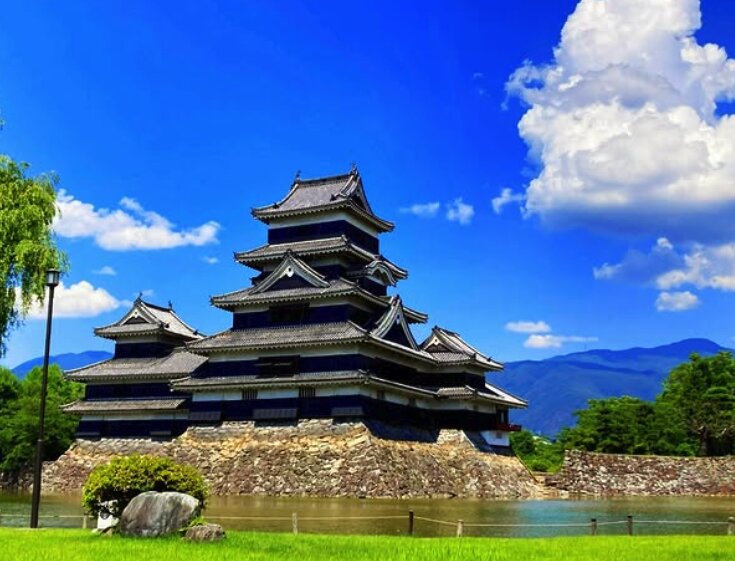
The Ishikawa builders compensated with water. The double moat system — inner and outer, fed by underground springs from the Northern Alps — created a water barrier that functioned as the equivalent of the cliff-faces protecting hilltop castles elsewhere. The outer moat measured over 170 metres at its widest. A castle relying on a double moat rather than elevation is called a hirajo (flatland castle), and Matsumoto is the finest surviving example in Japan. The moat reflection in calm morning light remains the castle's defining visual image — an accidental aesthetic consequence of a purely military engineering decision.
1603–1868 — The Edo Period: Six Families, 260 Years of Peace
After Tokugawa Ieyasu established the Edo shogunate in 1603 and ended the Sengoku wars, Matsumoto Castle's military purpose became largely ceremonial. The domain passed through six daimyo families across 260 years of peace — the Ishikawa, Ogasawara, Toda Matsudaira, Horita, Mizuno, and Toda clans — each leaving their administrative mark without fundamentally altering the keep.
The most significant peacetime addition was the Tsukimi-yagura — Moon-Viewing Turret — added by domain lord Matsudaira Naomasa in the 1630s. Attached to the southeast of the keep with elegant open sides and distinctive vermillion railings, it was designed for poetry gatherings and sake drinking during the autumn moon. The contrast between the black war-castle and the delicate pleasure turret — both visible from the moat — remains one of the most striking architectural juxtapositions in Japanese heritage architecture.
It was during the Edo period that the castle acquired the nickname Karasu-jo — Crow Castle — a reference to its black lacquered exterior boards and white plaster walls, which gave it the appearance of a crow spreading its wings against the sky.
1872 — The Near-Demolition That Almost Ended Everything
The Meiji Restoration of 1868 brought modernisation to Japan and, with it, a systematic policy of demolishing feudal castles as relics of the old order. Dozens of castle keeps across Japan were torn down between 1868 and the 1890s. Matsumoto Castle was sold at auction in 1872 with apparent intent to clear the site.
The castle was saved by one man — and by the community that supported him. Local businessman and educator Ichikawa Ryozo led a public campaign to buy the castle back and fund its restoration, arguing that the 300-year-old structure was irreplaceable and that its demolition would be a permanent loss for the city of Matsumoto.
Ichikawa succeeded. The castle was purchased back and a restoration effort funded by public contribution was completed between 1903 and 1913. It was community action — not government mandate, not aristocratic patronage — that kept Matsumoto Castle standing. This civic pride has never left the city, and locals will tell you the story unprompted to this day.
Context: Ichikawa Ryozo's 1872 campaign pre-dated Japan's first modern heritage protection laws by over 25 years. At the time of his campaign, there was no legal mechanism compelling preservation. He saved the castle on the strength of public persuasion alone.
1930–1952 — National Treasure
Matsumoto Castle was designated an Important Cultural Property in 1930 and elevated to National Treasure status in 1952 — Japan's highest level of cultural protection, awarded to objects and structures of exceptional historical or artistic significance. Of the five castles with this designation (alongside Himeji, Inuyama, Hikone, and Marugame), Matsumoto's main keep is the oldest surviving original structure.
Major restoration work between 1950 and 1955 stabilised foundations that had settled unevenly over three and a half centuries. A deliberate decision was made to correct the keep's lean only partially — a fully straightened keep was considered architecturally inauthentic. The slight lean remains visible today from the moat's south side.
2026 — The Castle Today
Seismic reinforcement work is underway at Matsumoto Castle in 2026. Sections of flooring have been removed for structural survey and underground drilling is visible along the tour route. The castle remains fully open throughout. For visitors on a guided Matsumoto Castle tour, the conservation work adds an unusual dimension: a live view of how Japan maintains its most significant heritage buildings.
The keep that you climb today — shoes off at the entrance, steep stairs, sixth-floor views across the Alps — is the same structure that Ishikawa Norimasa completed in 1594. That unbroken line of 430 years is the thing no photograph can fully convey, and the thing every good guide will take a moment to let you feel.
See the History in Person
A guided tour brings every chapter of this story to life — floor by floor, era by era. Entry included. From $70.
Browse Matsumoto Castle Tours